Kristallnacht
The Book ThiefKristallnacht, also known as the Night of Broken Glass, is the decisive escalation of Nazi persecution of Jews presented in the novel. On November 9, 1938, Jewish businesses and homes are attacked, glass is shattered, property is looted, and Jewish people are terrorized in public and private spaces. The event marks a violent break between the earlier legal and social exclusion of Jews and the openly destructive regime that follows. It is also a historical contradiction: the same night that destroys so many people becomes Max Vandenburg’s moment of escape.
Political and Social Background
Kristallnacht emerges from an atmosphere in which identity has been reduced to dangerous labels. Liesel Meminger’s dark brown eyes already place her uneasily within the racial expectations of Nazi Germany, while her father is remembered only through the incomprehensible word “Kommunist.” Later, Liesel begins to connect the word communist, a large bonfire, dead letters, her mother’s suffering, and her brother’s death with the Führer. This chain of association shows how private grief and state violence gradually become legible to a child as parts of one political system.
The legal foundation of persecution had already altered the meaning of Jewish identity. In 1935, the Nuremberg Laws stripped Jews of German citizenship and prohibited marriage between Jews and Germans. Max Vandenburg and Walter Kugler, once friends who had fought each other thirteen times, recognize that their old physical rivalry has been overtaken by a political order that treats their identities as a permanent boundary. Their former intimacy remains possible in memory, but the law has made ordinary social contact dangerous.
The pressure also reaches those who are not Jewish. As Jews are terrorized throughout the country, Hans Hubermann finally submits to the political demands of the regime and applies to join the Nazi Party in the spring of 1937. His decision is presented as a compromise made under mounting pressure, not as evidence that he hates Jews. The contradiction between party membership and personal conduct becomes stark when, after submitting his application at Nazi headquarters on Munich Street, he witnesses men attacking Kleinmann’s clothing store, one of the few Jewish shops still operating in Molching.
Violence Against Jewish Property and Families
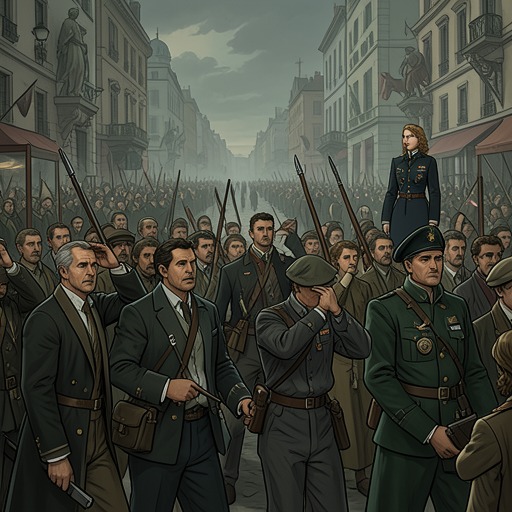
The attack on Kleinmann’s store anticipates the destruction of Kristallnacht in miniature. Four men throw bricks through the shop, while Joel Kleinmann cleans the broken glass and crushes it beneath his feet. A mustard-colored star is smeared across the door, and the words “JEWISH FILTH” are written across it in sloppy lettering. The violence is therefore both physical and symbolic: the shop is damaged, and its owner is publicly marked as contamination. The movement outside changes from hurried activity to a morose stillness before stopping altogether, suggesting a community that witnesses the assault and is either unwilling or unable to intervene.
Hans moves toward the ruined shop and offers help, but Kleinmann tells him to go away. Hans had painted Joel Kleinmann’s house the previous year and remembers the faces of his three children, though he cannot recall their names. That detail makes the scene personal without making it safe. Familiarity survives in Hans’s memory, but it cannot protect Kleinmann’s family from the political category imposed upon them.
Kristallnacht then appears as a nationwide event rather than an isolated local incident. On November 9, Jewish establishments are being systematically smashed and looted. The destruction is not spontaneous disorder; it is a coordinated assault in which violence against property announces the vulnerability of the people who own it. The broken glass gives the event its name, but the shattered windows are only the visible surface of a deeper attack on belonging, livelihood, citizenship, and physical security.
Max Vandenburg’s Escape
At the time of Kristallnacht, Max Vandenburg is twenty-two. He is crammed into an apartment living room with his aunt, mother, cousins, and their children while Jewish establishments outside are being destroyed. The family hears pounding on the door and a command to open it. They consider scattering into other rooms, yet apprehension immobilizes them; fear has become so complete that even movement seems impossible.
The event is described as the incident that destroys many of Max’s fellow Jews, but it simultaneously creates the opening through which he escapes. This reversal defines Kristallnacht’s place in Max’s life. It is not a rescue, and it does not lessen the catastrophe surrounding him. His survival begins inside a scene of collective danger, so his later existence remains inseparable from the people who could not get away.
Max’s vulnerability has been prepared by years of exclusion. After the Nuremberg Laws, he is dismissed along with the other Jews from the Jedermann Engineering Factory. Walter Kugler, his former opponent and eventual friend, can no longer meet him as an equal in the ordinary way; even their joking reference to fighting a Jew occurs under a law that forbids Jewish-German marriage. By Kristallnacht, social rejection has become a threat to life, and escape is no longer a matter of choosing a different job or preserving an old friendship.
Consequences and Historical Meaning
Kristallnacht transforms persecution from a process that can be denied or treated as temporary into a spectacle of unmistakable destruction. Its smashed businesses, marked doors, terrified families, and forced movement reveal the practical meaning of antisemitism under Nazi rule. The event does not merely add another episode of violence to the story; it confirms that Jewish people are being pushed outside the protections of German society and that ordinary bystanders must decide what their silence, compliance, or assistance means.
That moral pressure later shadows Hans Hubermann. His party application places him inside the system he distrusts, while his instinct to help Kleinmann exposes the distance between official allegiance and human recognition. Kristallnacht makes that distance dangerous. The novel therefore treats the event as both historical catastrophe and ethical test: the regime relies on labels, spectacle, and fear, while resistance begins with the refusal to regard a neighbor as only a label.
The consequences also extend into the novel’s later images of Jewish suffering. When Liesel Meminger and Hans watch Jewish prisoners being driven along Munich Street, the prisoners appear as a catalog of colors, their bones and souls reduced by starvation, dirt, and forced movement. That later scene is not Kristallnacht itself, but it carries forward the process that Kristallnacht makes visible: the conversion of people into persecuted bodies and public targets. The November violence thus stands as an early, decisive threshold in the history that will lead to still greater destruction.
Narrative Significance
Kristallnacht links the private and the historical scales of the novel. It reaches Liesel through the political word attached to her father, through the death of her brother and the suffering of her mother, through the books and fires that teach her how power uses language, and through the Jewish man who will eventually arrive on Himmel Street carrying both suffering and Hitler’s Mein Kampf. It also clarifies why books and words come to mean everything to her: language is used to classify, exclude, incite, and destroy, but it can also preserve individual lives against the abstractions imposed by the state.
The event’s strongest irony is its unequal distribution of consequence. For many Jews, Kristallnacht brings ruin, terror, and death; for Max, it provides a narrow route away from immediate capture. The escape does not cancel the violence. Instead, it makes survival feel historically burdened, because the person who lives carries knowledge of those who were trapped in the rooms, behind the doors, and within the communities being broken apart. In that sense, Kristallnacht is both an episode of persecution and the moment when the novel’s central moral economy becomes unavoidable: survival, complicity, memory, and human recognition cannot be separated.